The Emigrant Trail Museum
A Museum Dedicated to the Donner Party
As some of you may know, I am a huge history nerd. While my particular interests are in Central and Eastern European history, I do not discriminate, and enjoy all types of history. I believe that history gets a really bad wrap in society; most people find it boring. History most certainly can be boring, but I believe it is boring depending on the way it is presented. Every city and place has an interesting history that is just waiting to be discovered. The trick is to know what interests you and to be more active in learning about it... aka: go out and experience it. Oftentimes, you will be surprised that you do like different aspects of history, if it is taught/shown to you in the right way.
Since this is one of several posts about my trip home, many of you know I went to visit my brother in Reno, Nevada. On the way home, my mother, nephews, and I stopped at Donner Pass on the Emigrant Tail to visit the museum. We wanted to learn a bit more about that fateful journey of the Donner Party in 1846.
 |
| Front entrance for the Emigrant Trail Museum. |
The Donner Party was attempting to get to California from the east. There were several routes that were well established and relatively safe at that point in time. The typical route went from Missouri through Nebraska, Wyoming, and Idaho. In Idaho, travelers would split between the Oregon Trail and California Trail. However, people were always searching out new and faster routes.
 |
| Yoke for the oxen. |
The Donner Party, though, attempted one of these shortcuts, the Hastings Cutoff, which would end up being detrimental to their trip. The Hastings Cutoff split away from the typical path in Wyoming, adding a smaller mountain range to cross and the deadly Great Salt Lake Desert. While it appeared to be the more direct route, it added more miles and a lot more time to their travels. Therefore, the Donner Party arrived at the foot of the Sierra Nevada Mountains later than year.
 |
| Statue inside the museum depicting the travelers. |
Due to some disputes among the travelers, when they arrived at the Sierra Nevada Mountains there was a lot of tension in the group. The journey had been long and arduous with the most treacherous part of their trek still ahead of them. In their attempt to cross the mountain pass, the travelers became trapped by that winter's heavy snowfall.
 |
| Wood carving of westward travelers. |
There were several groups of people who had gone ahead to get help for those trapped in the snow. Many were unable to make it through and returned to camp, others died in the attempt to find help. Those who did make it through were unable to return with help, this was on account of the Mexican American War and the harsh weather conditions.
 |
| Person in the wild west. |
The families had settled into several cabins that had been built the previous year near Truckee Lake. The winter was very harsh on the travelers and they soon ran out of food supplies, some even resorted to cannibalism for survival.
 |
| Patty Reed's doll. |
The party was made up of 87 people, consisting of several families, including many children. One of the children, Patty Reed, kept this small doll with her throughout the journey. There is now a book written from the perspective of Patty Reed's doll of the Donner Party's story, named
Patty Reeds Doll: The Story of the Donner Party.
 |
| Snowshoes for horses. |
Help came in mid-February; a group of people arrived with food and to help people down the mountain. They were shocked to see the conditions that the people were living in and were unable to bring everyone down at once. There ended up being three different relief parties to bring the survivors the rest of the way to California.
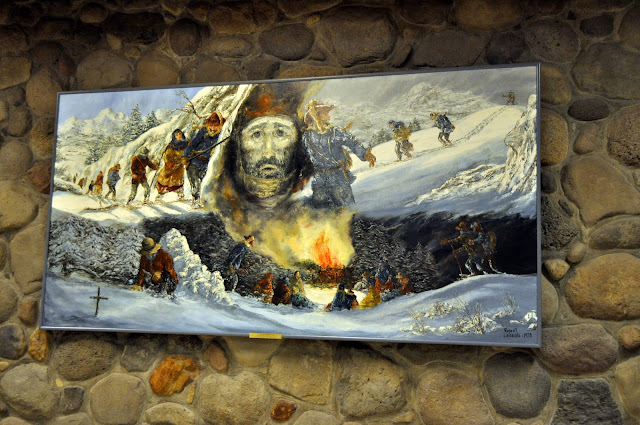 |
| Depiction of those in the Donner Party. |
There were only 48 survivors that made it to California. News spread of this event throughout the United States. While migration westward declined over the next several years, it was revived in 1849 with the California Gold Rush. Many people headed westward to get rich!
 |
| A lot of snow for this California girl. |
Today the area is named after this party of emigrants. There is Donner Lake, Donner Pass, and Donner Peak in the area and their tale is notorious.
 |
| Nephews at the memorial. |
There is a memorial where the party was stranded. The pedestal that holds the statue is 22 feet tall to represent the depth of the snow during the winter of 1846-1847.
 |
| Path leading up to the museum. |
Additionally, the area is now a popular place for skiers and snowboarders from around the world. If you are ever in the area, I recommend taking an afternoon to check out this awesome little museum and learn a little more about its history.
 |
| Amazing view of the Sierra Nevada Mountains. |
It is always a pleasure to share some of my adventures with our readers! I hope you enjoyed the story and maybe learned something new.
<3 Amy